

Cart
0
Table of Contents
- Are Heavy Duty Dog Leashes Worth It? The Honest Verdict
- What Makes a Leash Heavy-Duty: Materials, Clips, and Stitching
- The Best Heavy-Duty Dog Leash Options Compared
- A Durable Dog Leash for Large Dogs: Matching Weight and Hardware to Size
- Choosing a Dog Leash for Strong Pullers
- Rope vs. Nylon Dog Leash: Which Holds Up Longer?
- Total Cost of Ownership: Replacement Frequency and Real Value
- Heavy-Duty Leash vs. Harness, Collar, and Training Tools
- Frequently Asked Questions
Last Updated: October 17, 2026
Are Heavy Duty Dog Leashes Worth It? The Honest Verdict
Heavy duty dog leashes are worth it for owners of large, strong, or reactive dogs, and usually unnecessary for small, calm ones.
Most leash failures trace back to a single weak point: a cheap clip that bends, or stitching that pulls loose under sudden load.
If a dog weighs under 20 pounds and walks politely, a standard leash works fine.
What Makes a Leash Heavy-Duty: Materials, Clips, and Stitching
A leash qualifies as heavy-duty when its webbing, hardware, and stitching are all rated for load, not just sized for looks. Anything unrated is a guess.
Three components decide durability:
- Webbing: Wider nylon (25mm and up) spreads force across more fibers and resists tearing. Thin tape-style webbing frays faster at the handle.
- Clips: Zinc alloy or steel snaps with a locking gate hold better than stamped metal. A swivel prevents twisting that weakens stitching.
- Stitching: Box-X stitching at both ends distributes stress. Single-row stitching is the first thing to fail under a hard lunge.
Watch Out
The most common mistake is judging a leash by how thick it looks. A thick but cheap clip can fail before the webbing does. Check the hardware rating and the stitch pattern, not just the width.
The Best Heavy-Duty Dog Leash Options Compared
The best heavy-duty dog leash depends on the dog and the walk. Short control ropes suit training and crowded areas; longer straps suit sniffing and recall work.
Quick Comparison: Specs and Prices at a Glance
| Product | Material | Best For | Price |
|---|---|---|---|
| Short Training Traction Rope | Nylon | Close control, training | $9.93 |
| Anti Burst Traction Belt | Nylon | Large dogs, secure walks | $11.77 |
| Colorful Adjustable Sliding Leash | Nylon, zinc alloy hooks | Everyday walks, style | $13.40 |
| Nylon Retractable Leash | Nylon | Outdoor, casual walks | $11.17 |
| Reflective Retractable Leash Set | ABS | Low light visibility | $17.54 |
Pros and Cons of Each Pick
Anti Burst Traction Belt ($11.77): The retractable design gives a large dog room while keeping a secure hold.

Colorful Adjustable Sliding Leash ($13.40): A nylon strap with zinc alloy hooks and a plastic buckle, adjustable for different walks.
Nylon Retractable Leash ($11.17): Available in two widths and a wide color range, suited to outdoor use.
Reflective Retractable Leash Set ($17.54): The reflective rope adds visibility on evening walks, and the ABS housing is compact.
Pro Tip
For a strong dog, pair a short control rope with a longer leash and switch between them. The short rope handles sidewalks and crowds; the longer leash handles open space. One leash rarely does both well.
A Durable Dog Leash for Large Dogs: Matching Weight and Hardware to Size
A durable dog leash for large dogs should match the dog's weight and pull force, not just its collar size. A 90-pound dog generates far more sudden force than a 20-pound one.
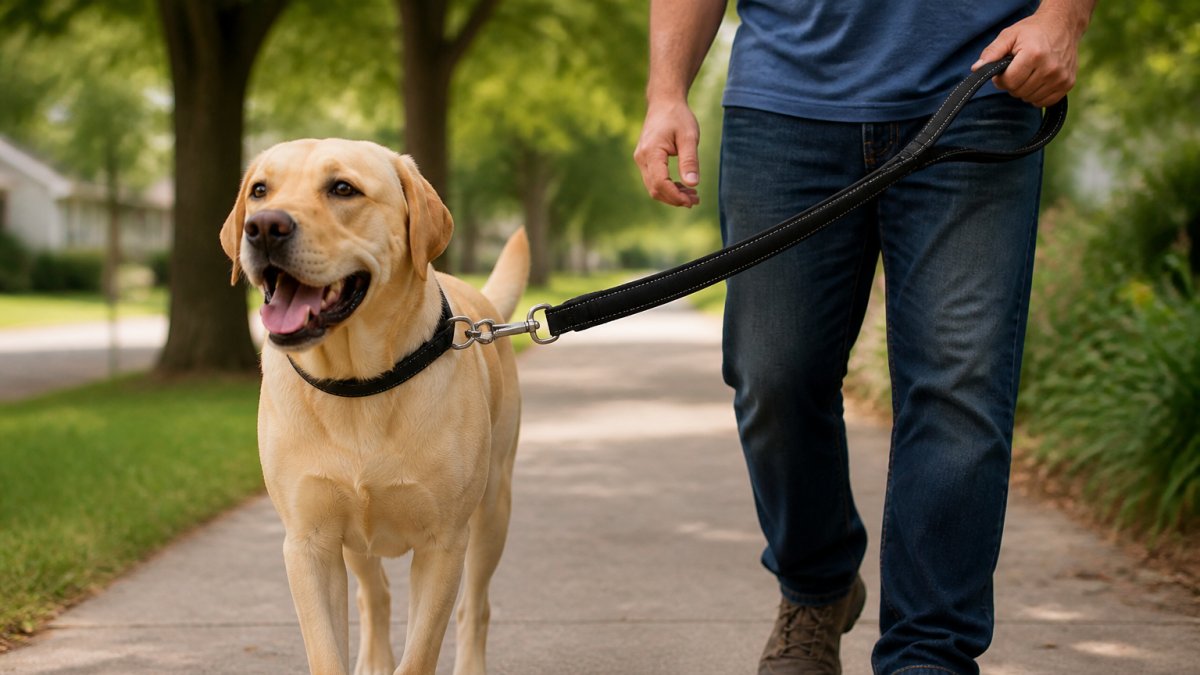
Match hardware to size with three rules:
- Under 20 pounds: standard 15-20mm webbing and a lightweight clip are enough.
- 20-60 pounds: go to 25mm webbing and a metal clip with a locking gate.
- Over 60 pounds or a known puller: choose the widest webbing offered, a rated metal clip, and reinforced stitching at both ends.
A heavy clip on a tiny dog adds weight and discomfort; a light clip on a big dog is the real risk. The Anti Burst Traction Belt and the Short Training Rope are both sized for large dogs, making them safer starting points for bigger animals.

Choosing a Dog Leash for Strong Pullers
For strong pullers, the leash is only half the system. A front-clip harness redirects pulling force, while a sturdy leash keeps the connection secure. Neither replaces training.
The leash itself should have a rated clip, reinforced stitching, and enough width to resist tearing.
What most guides miss is that a heavy-duty leash does not stop pulling. It survives pulling. The behavior fix comes from consistent leash training, reward-based redirection, and, for hard cases, a qualified trainer.
Rope vs. Nylon Dog Leash: Which Holds Up Longer?
Rope leashes generally resist abrasion and moisture better, while nylon webbing is lighter, cheaper, and easier to clean. Which lasts longer depends on where the dog walks.
Nylon webbing is strong for its weight and spreads load well, but its edges fray on concrete and rough ground, and it holds water and odor longer.
For beach and trail use, rope tends to outlast flat nylon. The Reflective Retractable Leash Set uses ABS housing with a reflective rope, which suits evening walks where visibility matters.
Short Pet Training Traction Rope For Large Size Walking Control →

Key Takeaway
Choose rope for wet, rough, or beach terrain. Choose nylon for everyday paved walks and lighter weight. Neither material fixes a weak clip.
Total Cost of Ownership: Replacement Frequency and Real Value
Heavy-duty leashes cost more upfront but usually need replacing less often, which is where the value shows. To decide whether the upgrade pays off, break the cost into three parts: purchase price, expected service life, and the cost of failure.
The per-walk cost math
A leash's real cost is its price divided by the number of walks it survives. A $12 standard nylon leash that frays after 8 months of daily walks costs about $0.05 per walk; a $30 heavy-duty leash with rated hardware and box-X stitching that lasts 3 years costs about $0.03 per walk.
The break-even point is roughly this: a heavy-duty leash priced at 2.5x a standard leash needs to last at least 2.5x as long to match it on cost per walk.
What actually drives replacement
Leashes rarely fail from old age. They fail at three points:
- The clip: stamped-metal snaps bend or lose spring tension; a bent gate no longer closes fully. A locking gate with a swivel is the single biggest durability upgrade.
- The stitching: single-row stitching at the handle or clip end pulls loose under a hard lunge. Box-X stitching at both ends distributes the load and is the pattern to look for.
- The webbing edge: concrete and rough ground fray the edges of flat nylon, and a frayed edge can propagate into a tear. Rope leashes resist edge abrasion better.
A leash that fails at any of these points is a replacement, not a repair. There is no safe field fix for a bent clip or pulled stitching, which is why the inspection habit below matters.
A 30-second inspection checklist
Run this check monthly and before any walk with a dog that lunges:
- Clip gate: squeeze the gate open and release it. It should snap shut with audible spring tension and sit flush. A gate that stays partly open is a failure waiting to happen.
- Swivel: rotate the clip. It should turn freely. A seized swivel twists the stitching under load.
- Stitching: look for loose threads, gaps between stitch rows, or any pull-away at the handle and clip ends. Box-X patterns should show no separation at the corners.
- Webbing: run a hand along both edges. Fraying that reaches the load-bearing fibers, or any cut or burn mark, means replace.
- Handle: check for padding separation or a worn-through outer layer that exposes the core.
A leash with a bent clip or pulled stitching is not a backup leash. Retire it. The cost of a replacement leash is trivial next to the cost of a dog getting loose near traffic.
When the upgrade does not pay off
For a dog under 20 pounds that walks politely, a standard leash rarely sees the loads that justify heavy-duty hardware. The extra durability is unused capacity, and a lighter leash is more comfortable on long walks. The owners who get the most from the upgrade are those whose dogs actually stress the clip and stitching: large breeds, strong pullers, and reactive dogs that lunge.
Heavy-Duty Leash vs. Harness, Collar, and Training Tools
A heavy-duty leash secures the connection, a harness manages pulling force, and a collar holds identification. They solve different problems and work best together. The gap most guides leave is the mechanism: why a harness changes a dog's pull and a stronger leash cannot.
How each tool actually works
- Leash: the safety link between handler and dog. Its job is to stay intact under load; the clip and stitching are the failure points, not the webbing.
- Harness: distributes force across the chest and shoulders instead of the throat. A front-clip harness attaches at the chest, so when the dog pulls forward, the leash angle turns the dog's body sideways. That redirection is what makes pulling less effective for the dog, and it is a mechanical effect, not a training one.
- Collar: holds tags and a backup connection. A flat collar is not a control point for a strong dog; throat pressure is a welfare concern and a poor lever against a 90-pound lunge.
Why a stronger leash does not stop pulling
A heavy-duty leash survives pulling; it does not prevent it. The dog's forward momentum comes from its hindquarters, and no leash material changes that. What changes pulling is management (a front-clip harness or head halter that makes pulling less rewarding) plus training (rewarding a loose leash).
This is the practical answer to whether heavy-duty leashes are worth it: they are worth it as safety equipment for dogs that generate sudden load, not as a behavior fix.
A simple decision framework
| Situation | Leash | Harness / Tool | Training focus |
|---|---|---|---|
| Small, calm dog, paved walks | Standard nylon, lightweight clip | Back-clip harness or collar | Basic loose-leash manners |
| Medium dog, occasional pulling | 25mm nylon, metal locking clip | Front-clip harness | Reward-based redirection |
| Large dog or strong puller | Heavy-duty, rated clip, box-X stitching | Front-clip harness, properly fitted | Structured loose-leash plan, trainer if needed |
| Reactive dog, crowded areas | Short control rope plus standard leash | Front-clip harness, backup collar connection | Distance and counter-conditioning work |
| Hiking or long-line recall | Heavy-duty rope or wide nylon | Well-fitted harness | Recall and long-line handling |
Budget for all three, not just the strongest leash on the shelf. A front-clip harness and a few training sessions will change how a dog walks far more than upgrading from a standard leash to a heavy-duty one.
The bottom line on tool choice
The leash keeps the dog attached; the harness and training change how the dog walks. Owners of powerful dogs should treat the heavy-duty leash as one part of a system, matched to the dog's size and pull force, paired with a force-redirecting harness and a training plan.
Frequently Asked Questions
Are heavy-duty dog leashes worth the extra cost?
For most owners of large or strong dogs, yes. A standard leash often costs $10 to $15 and may need replacing every few months under heavy pulling, while a well-built heavy-duty option in the $10 to $18 range holds up far longer. The math favors heavy-duty when your dog weighs over 50 pounds or pulls hard. For a calm small breed on gentle walks, a basic leash is fine and the upgrade rarely pays off.
What makes a dog leash heavy-duty?
Four things decide it: material thickness, clip strength, stitching quality, and handle construction. Heavy-duty leashes use wider nylon webbing or braided rope, metal clips rather than plastic, reinforced box stitching at stress points, and padded handles. Width matters too. A 2 cm to 2.5 cm strap spreads load better than a thin 1 cm cord. Check the attachment point where the clip meets the strap, since that is where most failures start.
Are rope or nylon leashes more durable?
Both last well when built properly, but they wear differently. Nylon webbing resists tearing and handles abrasion from pavement and brush, which suits daily neighborhood walks. Braided rope resists chewing and stays grippy when wet, making it a better fit for hiking, beach use, and long-line recall work. Nylon tends to fray at cut edges over time, while rope can develop burrs. Inspect either type monthly for wear.
Can a heavy-duty leash prevent a dog from escaping?
It reduces the risk but does not guarantee it. A strong leash with a secure metal clip and reinforced stitching is far less likely to snap when a dog lunges. The clip and collar attachment point remain the weak links, so pair a heavy-duty leash with a well-fitted collar or harness. For dogs that back out of collars, a harness with a backup clip is the safer setup. Training still matters more than hardware.
What should I check before buying a heavy-duty dog leash?
Inspect the clip first. A zinc alloy or metal clip with a locking gate beats plastic every time. Then check stitching at both ends, looking for double or box stitching rather than a single line. Confirm the width suits your dog's weight, and make sure the handle has padding if your dog pulls. Finally, match length to use: short leads for training control, longer lines for recall practice in open spaces.
Walking a strong dog safely takes the right combination of gear and training, and the leash is where that connection starts. SnugglePawsPetSupplies carries large-dog options like the Anti Burst Traction Belt and the Short Training Traction Rope, backed by a quality promise, fast shipping, and easy returns. Matching a rated leash to the dog's size and pull force is the first step toward calmer, safer walks. Check Out the large-dog leash collection and find the fit for a specific dog.

