

Cart
0

Table of Contents
- How Interactive Play Helps Anxious Kittens
- Quick Comparison: Best Interactive Toys for Anxious Kittens
- 1. Interactive Feather Bouncy Ball Pet Toy Set: Best for Shy Kittens Who Need Solo Play
- 2. Retractable Suction Cup Pet Teaser Exercise Toy: Best for Building Confidence Through Interactive Cat Toys
- 3. Self-Balancing Tumbler Interactive Pet Toy: Best for Kittens Startled by Fast Movement
- 4. Rotating Interactive Slow Feeder Treat Dispensing Toy: Best Puzzle Toy for Kittens Who Eat Too Fast
- 5. Foldable Pet Tunnel With Storage Design: Best for Kittens Who Hide When Scared
- 6. Fully Automatic Intelligent Interactive Pet Toy: Best for Busy Households
- 7. Removable Felt Pet Tunnel Play Toy: Best for Multi-Cat Homes With One Anxious Kitten
- How to Calm an Anxious Kitten: Matching Toys to Triggers
- Frequently Asked Questions
Last Updated: October 16, 2026
How Interactive Play Helps Anxious Kittens
An anxious kitten that hides under the sofa all day is not a lost cause, and the fix is often simpler than owners expect. Interactive play gives a nervous kitten a safe way to act on its hunting instincts, and that daily outlet does more for stress than most calming sprays or plug-in diffusers. This guide from SnugglePawsPetSupplies walks through the best interactive toys for anxious kittens, matched to the specific triggers that set each cat on edge.
Anxious kittens are young cats that show fear-based behavior such as hiding, flattening their ears, freezing mid-play, or avoiding contact with people and other pets. The behavior usually traces back to a lack of early socialization, a loud or unpredictable household, or a sudden change in routine.
Play works because it borrows a cat's natural sequence: stalk, chase, pounce, catch. When a kitten completes that sequence, the body releases tension instead of storing it. A kitten that never gets to finish the hunt stays on edge.
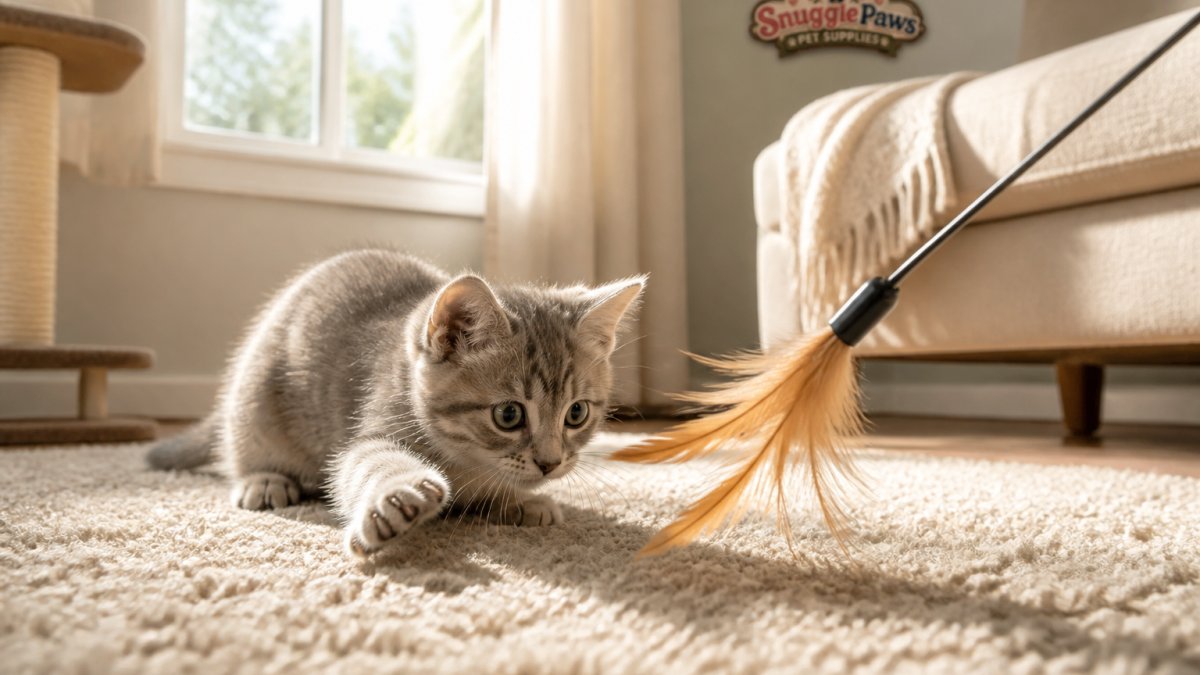
That is the theory. Here is what most guides get wrong: they recommend buying a pile of toys and leaving the kitten alone with them. An anxious kitten will not engage with a strange object on its own. It needs a slow introduction first, which is where most owners give up too early.
Quick Comparison: Best Interactive Toys for Anxious Kittens
The table below matches each toy to the anxious behavior it suits best, so owners can skip straight to the right pick. The columns that matter most for a nervous kitten are motion speed, noise level, and whether the toy needs a human to run it.
| Toy | Price | Best For | Motion & Noise | Age Fit |
|---|---|---|---|---|
| Interactive Feather Bouncy Ball Set | $11.61 | Shy kittens who play alone | Unpredictable roll, silent | 8 weeks and up |
| Retractable Suction Cup Teaser | $12.21 | Building confidence through guided play | Owner-controlled speed, quiet | 10 weeks and up |
| Self-Balancing Tumbler | $14.37 | Kittens startled by fast movement | Slow rock and tip, silent | 8 weeks and up |
| Rotating Slow Feeder | $12.30 | Kittens who eat too fast | Rolls when batted, quiet | 3 months and up |
| Foldable Pet Tunnel | $13.62 | Kittens who hide when scared | Static, no noise | 8 weeks and up |
| Fully Automatic Interactive Toy | $19.56 | Busy households | Self-propelled, low hum | 4 months and up |
| Removable Felt Tunnel | $25.52 | Multi-cat homes | Static, sound-dampening felt | 8 weeks and up |
A common mistake is buying the flashiest toy on the shelf. For a nervous kitten, a slow-moving object it can approach on its own terms beats a fast, noisy one every time.

Safety notes before you buy
Interactive toys for kittens carry risks that general cat-toy guides often skip. Keep these in mind for every pick on the list:
- Supervise wand and string toys. Feathers, strings, and elastic cords can be swallowed if a kitten chews through them. Put wand toys away in a closed drawer after each session, not on the floor.
- Check detachable parts weekly. Feather tails, bells, and small plastic clips loosen over time. Pull on each attachment and remove anything that wiggles free.
- Treat battery and rechargeable toys with care. Keep charging cables out of reach, and unplug automatic toys when no one is home if the kitten is still in the chewing stage.
- Skip anything smaller than a ping-pong ball for kittens under three months, since small parts are easier to swallow.
- Inspect tunnels for wire ends. If the steel frame pokes through the fabric, retire the tunnel rather than taping it.
- Store toys out of reach between sessions. A toy that lives on the floor loses novelty and becomes a chewing target.
Watch Out
No interactive toy replaces supervision. Anxious kittens are more likely to chew or bolt, so treat every new toy as a supervised activity for the first week.
How to use this list
Start with the behavior you see most often, not the price. A kitten that hides needs a tunnel before it needs a puzzle feeder. A kitten that startles at motion needs the tumbler before the automatic toy. Once one toy is working, add a second from a different category so the routine has variety without overwhelming the cat.
1. Interactive Feather Bouncy Ball Pet Toy Set: Best for Shy Kittens Who Need Solo Play
Shy kittens often need a toy that moves without a human standing over them. This set delivers exactly that: six silent elastic balls with natural chicken feathers attached, designed to roll and jump in unpredictable patterns that mimic prey.
The unpredictable movement is the point. A ball that rolls in a straight line gets boring in seconds. One that darts and stops triggers the chase reflex, and the kitten can stalk it from a distance before committing.
What works:
- Six balls mean a kitten can lose one under the couch without ending playtime
- Silent construction suits apartments and households with light sleepers
- The six extra feather tails convert the set into a wand-style game for hands-on sessions
What does not: the feathers will not survive a determined chewer forever. Owners should check them weekly and remove any loose pieces.
At $11.61, this is the lowest-risk entry point for a kitten that has never shown interest in toys before. SnugglePawsPetSupplies stocks it as a starter pick for exactly that reason.
2. Retractable Suction Cup Pet Teaser Exercise Toy: Best for Building Confidence Through Interactive Cat Toys
Interactive cat toys work best when the owner controls the pace, and this suction-cup teaser hands that control back to the person. The base sticks to a hard floor or wall, and the retractable wand extends and pulls back at whatever speed the kitten can handle.
That adjustability matters for a nervous cat. A kitten that flinches at fast motion can start with slow, short pulls and build up over days. The ABS build weighs just 41 grams, so it moves lightly and does not clatter.
Stick the suction base to a surface at the kitten's eye level, not above its head. Overhead movement triggers a flinch response in anxious cats, while side-to-side motion at ground level invites a pounce.
The one drawback is the suction cup itself. On textured or dusty floors it loses grip, so smooth tile or sealed wood works best.
3. Self-Balancing Tumbler Interactive Pet Toy: Best for Kittens Startled by Fast Movement
Some kittens shut down the moment a toy moves quickly. The self-balancing tumbler solves that by never moving fast in the first place. It rocks, tips, and rights itself at a slow, predictable rhythm that a cautious cat can track with its eyes before touching it.

Built from HIPS and PC at 235 grams, it sits heavy enough that a light bat will not send it skittering across the room. The 142 by 107 mm size is small enough for kitten paws to reach around.
Owners should expect a slow burn with this one. A confident kitten may ignore it. A nervous kitten often stares at it for a full session before making contact, and that first touch is the win.
4. Rotating Interactive Slow Feeder Treat Dispensing Toy: Best Puzzle Toy for Kittens Who Eat Too Fast
Puzzle toys for kittens do double duty: they slow down fast eaters and give a nervous cat a job to do. This rotating dispenser releases kibble or treats as the kitten bats and rolls it, turning mealtime into a low-stakes hunt.
The plastic build weighs 310 grams, heavy enough to stay upright during enthusiastic play. Owners can start with easy dispensing and tighten the openings as the kitten gets the hang of it.
Interactive Feather Bouncy Ball Pet Toy Set →
Watch Out
Never leave a treat-dispensing toy down as free food all day. An anxious kitten that overeats from boredom can develop digestive upset, and the toy loses its value as a puzzle once the food is gone.
This is also one of the better kitten enrichment ideas for owners who work long shifts. A food puzzle keeps a nervous cat occupied during the quiet hours when the house feels empty.
5. Foldable Pet Tunnel With Storage Design: Best for Kittens Who Hide When Scared
A kitten that bolts under the bed every time the doorbell rings needs a hiding spot it can call its own. This foldable tunnel gives it one that is also a toy, so hiding turns into a launch pad instead of a retreat.
The steel-wire frame holds its shape, and the elastic mesh sides let a kitten peek out without being seen. Feather attachments at the openings encourage a cautious cat to reach out and swat. It measures about 65 cm long with a 25 cm diameter, which suits a kitten but will feel tight for a full-grown cat.
The storage design is the practical win. It collapses flat, so owners can put it away when guests arrive and bring it back out once the house is calm again.

6. Fully Automatic Intelligent Interactive Pet Toy: Best for Busy Households
Automatic toys solve a real problem: an anxious kitten left alone for nine hours needs stimulation that does not depend on a human being home. This rechargeable unit runs on its own and includes a charging cable, so there is no battery run to make mid-week.
At 0.06 kg it is light, and the PC/ABS shell wipes clean easily. The red finish makes it simple to spot when it rolls under furniture.
The honest limitation is that automatic toys cannot read a kitten's mood. A nervous cat may need the owner to sit nearby for the first few sessions before it engages with a moving object that nobody is controlling. Use it as a supplement to hands-on play, not a replacement.
7. Removable Felt Pet Tunnel Play Toy: Best for Multi-Cat Homes With One Anxious Kitten
Multi-cat homes create a specific problem: the confident cats hog every toy, and the anxious one gets pushed out. This felt tunnel gives the nervous kitten a separate zone with two exits, so it never feels cornered.
The felt and metal buckle construction is soft enough to nap in and sturdy enough to hold shape. At 91.5 cm long and 44 cm wide, it is noticeably roomier than the foldable option, and the 5 mm thickness adds a little insulation from household noise. Four color pairings let owners match it to a room.
Key Takeaway
The most important feature for an anxious kitten in a multi-cat home is a second exit. A tunnel with only one opening turns into a trap when another cat blocks the entrance.
How to Calm an Anxious Kitten: Matching Toys to Triggers
Learning how to calm an anxious kitten starts with identifying the trigger, not buying more toys. Fear of fast movement, fear of noise, fear of other cats, and plain boredom all look similar from across the room but need different fixes. Most guides stop at a bullet list. The part that actually changes behavior is the introduction routine and the kitten's age, because a nine-week-old and a six-month-old do not play the same way.
Match the toy to the trigger
- Hides when people enter: foldable tunnel plus slow, low wand play at ground level, with the owner seated rather than standing
- Startles at quick motion: self-balancing tumbler, introduced from across the room and allowed to sit still for a full session before any interaction
- Bolts at loud sounds: silent elastic balls and felt toys with no rattling parts, no bells, no crinkle plastic
- Eats too fast or begs constantly: rotating slow feeder for structured meals, emptied and put away between feedings
- Freezes when other cats approach: felt tunnel with two exits, placed away from shared food, water, and litter
- Left alone for long stretches: automatic rechargeable toy plus a food puzzle, rotated so the same toy is not out every day
Adjust the plan to the kitten's age
Kitten play style shifts fast, and a toy that works at one stage can frustrate the next.
- 8 to 12 weeks: coordination is still developing, so wand tips should stay low and slow. Short sessions of three to five minutes match a very short attention span. Small, lightweight toys are easier to bat and carry.
- 3 to 4 months: chasing and pouncing sharpen, and the kitten can track faster motion. This is when a suction-cup teaser or a rolling ball starts to pay off. Sessions can stretch to five to eight minutes.
- 5 to 6 months: stamina and problem-solving jump. Puzzle feeders and treat dispensers hold attention longer, and the kitten can handle a toy that requires batting, rolling, and waiting for a reward.
- 7 months and up: play looks more like adult hunting. Rotate toys weekly so novelty does not wear off, and keep at least one hands-on wand session in the daily routine.
Introduce any new toy the same way
A predictable routine lowers the stakes for a nervous kitten. Most practitioners find that a slow, low-pressure introduction works better than dropping a toy in front of a hiding cat.
- Place, don't present. Set the toy on the floor near the kitten's safe spot and walk away. Do not push it toward the cat.
- Let distance do the work. Give the kitten a full session to watch from wherever it feels safe. Staring is progress.
- Reward the first approach. The moment the kitten touches or sniffs the toy, stay still and quiet. No praise, no sudden movement.
- Start short. Once curiosity wins, run a five- to ten-minute session, two or three times a day. Short and frequent beats one long marathon.
- End on a win. Stop while the kitten is still engaged, before it loses interest or gets overstimulated. That keeps the toy associated with success.
Read the difference between play and stress
A kitten that pauses, resets, and comes back for more is having fun. A kitten that flattens its ears, hisses, freezes with dilated pupils, or suddenly grooms mid-session is telling you to stop. Other signs to pause: a twitching tail tip that escalates to a full lashing tail, a sudden bolt from the room, or a refusal to re-engage after a break. When you see those, put the toy away, give the kitten space, and try again later at a slower pace.
Toys support enrichment and build confidence, but they are not a guaranteed treatment for anxiety. If a kitten hides constantly, stops eating, or shows fear that does not ease with a consistent play routine, that is a conversation for a veterinarian.
American Society for the Prevention of Cruelty to Animals cat behavior resources notes that environmental enrichment and predictable routines reduce stress behaviors in indoor cats, and the American Association of Feline Practitioners publishes guidance on feline environmental needs that supports the same approach.
Owners who want a single place to start can browse the SnugglePawsPetSupplies cat toy range, which carries every pick in this list along with fast shipping and easy returns if a kitten rejects a toy.
Frequently Asked Questions
What are some good interactive toys for anxious kittens?
Toys that move slowly and predictably work best. A self-balancing tumbler ($14.37) wobbles gently without sudden bursts, and the Interactive Feather Bouncy Ball set ($11.61) lets a shy kitten play alone with silent elastic balls. For hands-on bonding, try the Retractable Suction Cup Teaser ($12.21), which you control so play stays calm and never overwhelming. Avoid fast, loud electronic toys until your kitten settles.
How often should I play with my anxious kitten?
Two to three short sessions a day, about 10 to 15 minutes each, give a kitten enough activity without stress. Anxious kittens often shut down after 5 minutes at first, so stop while they are still engaged. A suction-cup teaser or feather wand works well for these short bursts, and a treat-dispensing toy ($12.30) can fill quiet stretches between sessions.
Are puzzle toys for kittens safe for an anxious cat?
Yes, when you pick the right size and supervise the first few uses. The Rotating Interactive Slow Feeder ($12.30) has no small detachable parts, so it suits kittens learning to eat more slowly. Skip anything with loose bells, string, or foam pieces a kitten could chew off. Check toys weekly for cracks or wear, and put them away when you cannot watch.
What should I do if my kitten is afraid of toys?
Leave the toy on the floor near their resting spot and let them approach on their own. Do not push it toward them or make sudden movements. A tunnel like the Foldable Pet Tunnel ($13.62) gives a scared kitten a safe place to watch from. Once they bat at the toy once, end the session and repeat the next day. Confidence builds in small steps.
Can interactive toys help a nervous kitten feel more confident?
Interactive play lets a kitten practice hunting, stalking, and pouncing in a controlled setting, which builds confidence over time. Wand toys you control are especially useful because you can match the pace to your kitten's comfort level. Pair short play sessions with kitten enrichment ideas like tunnels and sniffing mats ($17.62) so there is always a low-pressure way to explore.

