

Cart
0

Last Updated: October 23, 2026
Quick Summary
The best travel crates for small breed puppies balance correct fit, secure containment, and easy portability, and you should measure for adult size rather than puppy size. Buy a crate with a belt path or metal tie-down points for car trips, and verify airline under-seat dimensions before flying.
- Measure your puppy standing and add two to four inches for turning room and growth.
- Use a divider panel to shrink space for a young puppy and expand it as it grows.
- A crate with no belt path and no metal tie-down points cannot be safely secured in a car.
- Confirm the airline's under-seat dimensions, weight limit, and age rules before booking.
- Clean accidents with an enzymatic cleaner, since standard soap leaves residue that triggers repeat marking.
Table of Contents
- What to Look for in Travel Crates for Small Breed Puppies
- How to Measure a Puppy for a Crate
- Car Travel Crate for Small Dogs: Safety and Crash-Test Limits
- Choosing an Airline-Approved Dog Carrier
- Puppy Crate Training Tips for Travel and Home
- Cleaning and Hygiene for Puppy Accidents on the Go
- Common Mistakes to Avoid When Buying Travel Crates
- Conclusion
- Frequently Asked Questions
What to Look for in Travel Crates for Small Breed Puppies
The best travel crates for small breed puppies balance three things: correct fit, secure containment, and easy portability. New puppy owners often sort through these trade-offs, and the pattern is consistent. Most buyers focus on looks first and measurements second. That order should be reversed.
A travel crate is a portable enclosure that keeps a small dog contained and comfortable during car rides, flights, hotel stays, and visits. Unlike a permanent home crate, it must fold, carry, and fit into tight spaces without sacrificing safety.
This guide covers materials, sizing, car safety, airline rules, and the costliest mistakes.
Materials: Soft-Sided vs. Hard-Sided vs. Wire
Soft-sided crates use fabric panels over a frame.
Hard-sided plastic shells hold their shape, contain accidents and motion sickness messes, and meet most airline cargo standards. They are heavier and bulkier to store.
Wire construction offers the most ventilation and visibility and suits home use and crate training, but it provides little crash protection and is awkward to carry.
A common mistake is buying soft-sided for a puppy that chews.
Ventilation, Visibility, and Secure Latches
Puppies regulate heat poorly, so airflow matters more than most buyers expect. Look for mesh panels on at least two sides and a top opening on soft crates.
Visibility cuts travel anxiety. A puppy that can see its owner settles faster in the car.
Latches deserve close inspection. Press-and-slide latches resist escape better than simple zippers, and a second locking clip stops a clever puppy from nosing the closure open.
How to Measure a Puppy for a Crate
Measure a puppy standing, not sitting or curled up.
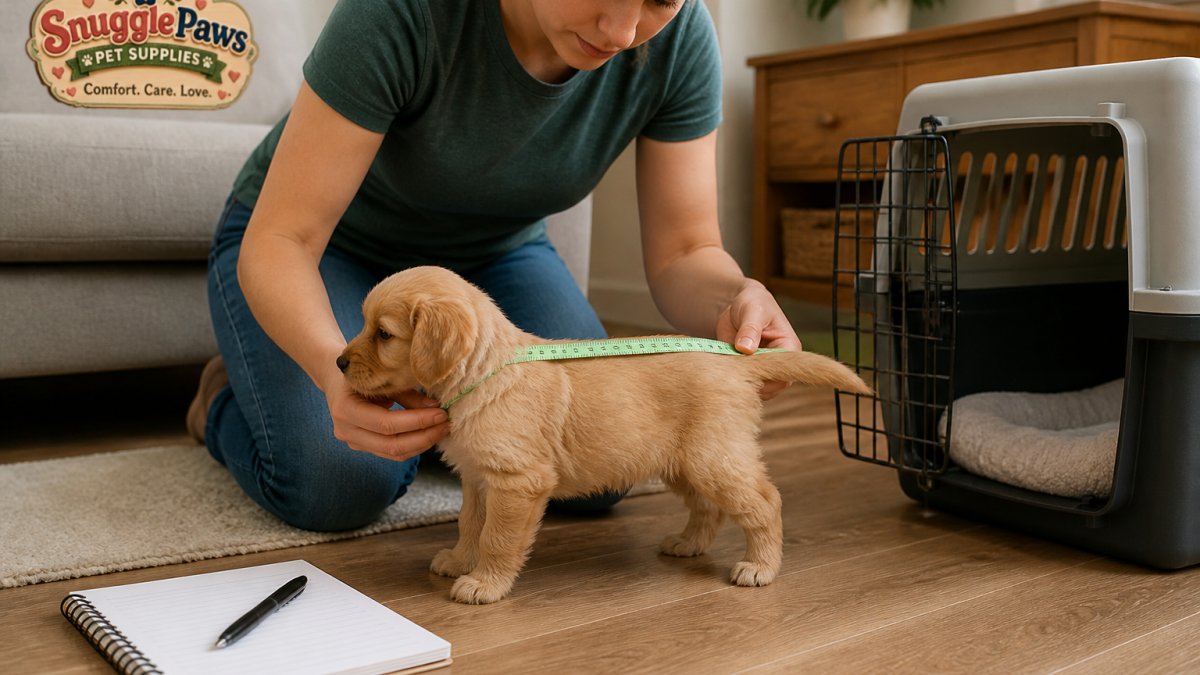
Puppy sizing is where most guides fall short. A crate that fits at ten weeks will not fit at six months.
The divider trick matters for house training too. Puppies avoid soiling where they sleep, so an oversized crate invites accidents in the corner. Size the usable space to standing-and-turning room and expand it as the puppy grows.
Car Travel Crate for Small Dogs: Safety and Crash-Test Limits
A car travel crate for small dogs should be secured, not just placed on the seat. An unsecured crate becomes a projectile in a sudden stop, and a small puppy inside it has no protection at all. At 30 mph, a 10-pound crate and puppy can strike the seatback with roughly the force of a 300-pound object, which is why car travel deserves its own rules, separate from airline or public-transport travel.
How car crates actually stay put
There are three common anchoring methods, and they are not equal:
- Seat-belt routing. The vehicle's lap belt passes through the crate's designated belt path or around its frame. This is the simplest method and works with most hard-sided crates that publish a belt path.
- Tie-down straps to cargo anchors. Straps hook to the crate's reinforced tie-down points and clip to the vehicle's cargo-area D-rings. This is the most stable option for SUVs and hatchbacks, but only if the crate has metal-reinforced anchor points rather than sewn fabric loops.
- LATCH / ISOFIX-style connectors. A small number of carriers offer rigid connectors that lock into the vehicle's lower child-seat anchors. These are the most secure when present, but they are rare in the small-puppy category.
A crate with no belt path and no metal tie-down points cannot be safely secured, no matter how sturdy it feels. Check for those features before anything else.
What "crash tested" actually means
Crash-test evidence is thin in this category, and buyers should treat marketing claims with caution. No federal regulation certifies pet crates for crash safety, and the word "tested" is not standardized.
The Center for Pet Safety publishes independent crash-test evaluations of pet restraints and carriers, and its findings are worth checking before trusting a label. When you read any test report, look for four things: the test speed, the sled or vehicle setup, the weight of the test dummy, and whether the crate stayed intact and attached.
Watch Out
A crash rating does not guarantee protection in every collision. It indicates that a specific crate, secured a specific way, survived a specific test. Angle of impact, vehicle type, and installation all change the outcome.
Car vs. airline vs. public transport: three different jobs
Most guides treat "travel crate" as one product. It is not. A car crate needs rigid anchoring and impact resistance. An airline in-cabin carrier needs soft sides and exact under-seat dimensions.
If most of your travel is by car, prioritize a hard-sided crate with a belt path and metal tie-down points. If most is by air, prioritize a soft-sided carrier sized to your airline's under-seat space.
Practical rules for car travel
- Place the crate on the back seat or cargo area, never the front passenger seat
- Route the seat belt through the crate's belt path or use a cargo anchor strap on metal tie-down points
- Remove loose bedding and toys that could shift during braking
A hard-sided crate with reinforced tie-down points offers more protection than fabric. Soft-sided carriers are convenient for carrying a puppy into a store, but they are not a crash-safety solution. For a small-breed puppy, the right car setup is a crate sized to adult weight, anchored to the vehicle, with just enough bedding to be comfortable and nothing loose to become a second projectile.
Choosing an Airline-Approved Dog Carrier
An airline-approved dog carrier must fit the specific airline's under-seat dimensions, not a generic "airline approved" label. Dimensions vary by airline, aircraft, and even seat row, and a carrier that fits the seat may still be rejected at the gate if the puppy cannot stand and turn inside it.
The three numbers that decide everything
Before you book, get three numbers from the airline, not from the carrier's marketing:
- Under-seat dimensions for the specific aircraft and cabin. These are usually listed as length × width × height, and the height is almost always the binding constraint. Many in-cabin carriers are built to a soft-sided height that compresses slightly, which is why soft-sided carriers dominate this category.
- Weight limit for the pet plus carrier. Limits commonly fall in the 15-20 pound range for in-cabin travel, but they vary by airline and should be confirmed directly.
- Age and health requirements. Most airlines require puppies to be at least eight weeks old and fully weaned, and many require a health certificate issued within a set window before travel. Verify current rules with the airline, since policies change.
In-cabin vs. cargo: a real fork in the road
For a small-breed puppy, in-cabin travel is almost always the better choice when it is allowed. The puppy stays with you, you can monitor stress and bathroom needs, and you avoid the temperature and handling variables of cargo.
Cargo travel is the fallback for puppies that exceed in-cabin limits or for routes where in-cabin pets are not allowed. Cargo crates must meet different construction standards, rigid walls, a metal door, ventilation on multiple sides, and often a specific latch type, set by the airline, not a universal standard.
Pro Tip
Measure your puppy and your candidate carrier at home, then test the fit by having the puppy stand, turn around, and lie down inside with the carrier closed for a few minutes. If the puppy cannot do all three comfortably, the carrier is too small, regardless of what the label says.
What to look for in an in-cabin carrier
For in-cabin travel, a soft-sided carrier with mesh ventilation on three sides and a washable liner works best. Look for:
- A soft frame that compresses slightly to slide under the seat without collapsing on the puppy
- Mesh panels on at least two sides, ideally three, for airflow
- A secure closure, zippers with locking clips resist a puppy nosing the carrier open
The U.S. Department of Transportation air travel guidance outlines consumer protections and airline obligations for pets flying in the cabin, and it is worth reading before you book. Confirm the carrier's dimensions against the airline's published under-seat measurements, and confirm the puppy's fit inside the carrier before the flight. A carrier that fits the puppy but not the seat is a wasted purchase, and a carrier that fits the seat but not the puppy is a welfare problem.
Puppy Crate Training Tips for Travel and Home
Crate training starts at home, weeks before any trip.
Start with short sessions. Leave the crate open with bedding and a treat inside, and let the puppy explore on its own.
What most guides miss is the value of the same crate for home and travel.
For travel anxiety, a worn t-shirt with the owner's scent, a familiar blanket, and a consistent pre-trip routine help more than any gadget.
Cleaning and Hygiene for Puppy Accidents on the Go
Puppy accidents happen, especially on long trips and in new places. A crate with a removable, machine-washable liner and a leak-resistant base saves hours of scrubbing.
Clean accidents immediately with an enzymatic cleaner. Standard soap leaves residue that tells a puppy the spot is still a bathroom, and the behavior repeats.
For car travel, line the crate base with an absorbent pad under the bedding.
Common Mistakes to Avoid When Buying Travel Crates
Buying for puppy size instead of adult size tops the list. A crate sized for a ten-week-old will be outgrown within months, and the money is wasted.
Other frequent errors:
- Trusting an "airline approved" label without checking the specific airline's dimensions
- Choosing a soft-sided crate for a chewer
- Skipping the divider panel and creating house-training setbacks
| Mistake | Fix | Why It Matters |
|---|---|---|
| Sizing to puppy, not adult | Measure adult breed range, use divider | Avoids repurchasing within months |
| Generic "airline approved" claim | Verify airline's under-seat dimensions | Prevents denied boarding |
| Soft-sided crate for a chewer | Switch to hard-sided or wire | Prevents escape and injury |
| Unsecured car crate | Use tie-down points and seat belt | Reduces projectile risk in a stop |
| No washable liner | Choose removable, machine-washable bedding | Simplifies accident cleanup |
Conclusion
Every puppy owner eventually faces the same challenge: a trip that requires a safe, comfortable crate and a puppy that has never spent a night in one.
SnugglePawsPetSupplies offers a curated selection of premium pet essentials, from cozy beds to grooming tools, making pet ownership more enjoyable and ensuring your cherished companions experience enhanced comfort and happiness.
Check Out SnugglePawsPetSupplies and give a small-breed puppy a crate that fits today and still fits next year.
Frequently Asked Questions
What is a good small travel crate for dogs?
A good small travel crate fits your puppy's current measurements with room to stand, turn, and lie down, and matches your travel mode. Soft-sided crates suit car rides and hotel stays, while hard-sided carriers meet most airline cabin rules. Look for secure latches, mesh ventilation, a washable liner, and tie-down points if you plan to use it in the car. Measure your puppy before buying and check the crate's weight range, since small-breed puppies grow quickly in the first year.
How do I choose the right travel crate size for a small puppy?
Measure your puppy from the tip of the nose to the base of the tail, then add 2 to 4 inches for growth. Measure height from floor to the top of the head, adding 2 to 3 inches so the puppy can stand without crouching. Compare those numbers to the crate's interior dimensions, not the exterior. For a puppy expected to reach 15 to 25 pounds, buy for the adult size if the crate includes a divider panel, which lets you shrink the space now and expand it as the dog grows.
Are soft-sided or hard-sided travel crates better for small puppies?
Soft-sided crates are lighter, easier to fold, and simpler to store, which helps for car trips and visits. Hard-sided carriers hold their shape, resist chewing better, and are the usual choice for airline cabin travel because they meet rigid dimension rules. A common approach is a soft-sided crate for everyday car travel and a hard-sided, airline-approved carrier for flights. Whichever you pick, confirm the zippers or latches lock and that the mesh is chew-resistant for teething puppies.
Can a puppy travel safely in a crate in the car?
A crate keeps a puppy contained, but it is not automatically crash-safe. Look for a crate with a crash-test rating and tie-down points, and secure it with the vehicle's seat belt or anchor straps so it cannot slide. Place the crate on the back seat or cargo area, never in front of an active airbag. Even with a tested crate, a puppy should not ride loose, and you should plan short trips first so the puppy adjusts to motion before a long drive.


